

┐(´ー`)┌ヤレヤレ、良く見ろ馬鹿子
| logicsayer 10-08 19:22:04 |

 韓国語で表示 韓国語で表示 |
| ここでの核心! 君が提示した[A] kemukemu1の [Kenneth T. Young, Jr.,書簡]には/[rocks belong to Japan ]が,元々はなかったということを君が認めなさいと! | |
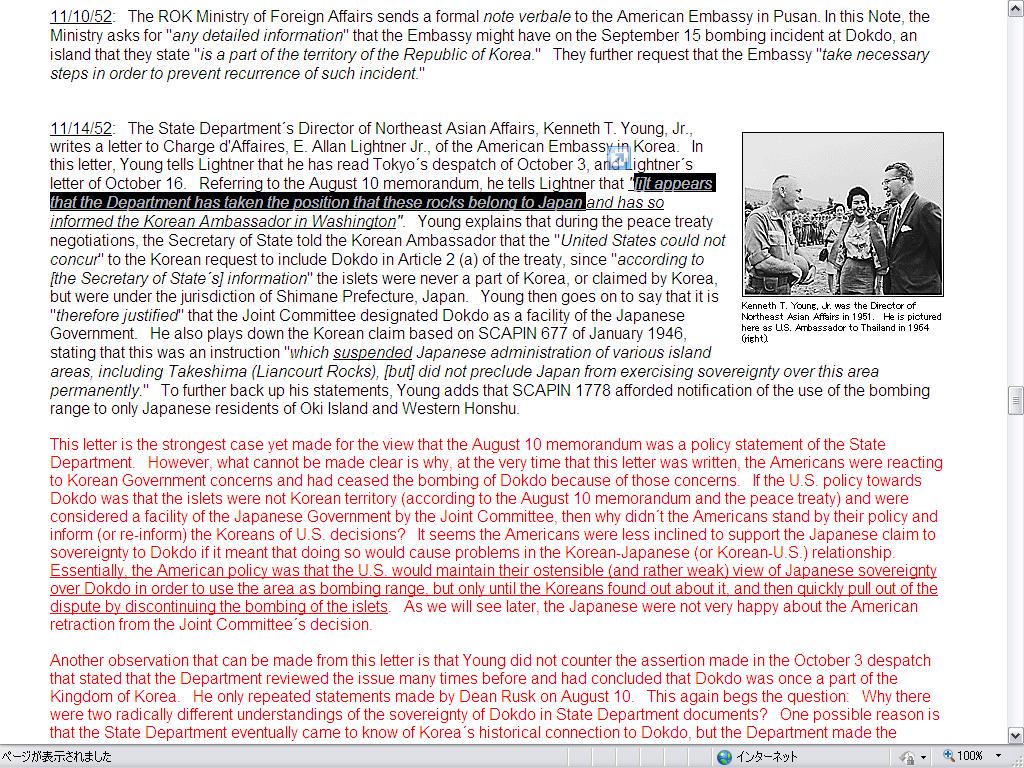
11/14/52
: The State Department´s Director of Northeast Asian Affairs,
Kenneth T. Young, Jr., writes a letter to Charge d"Affaires, E. Allan Lightner
Jr., of the American Embassy in Korea. In this letter, Young tells Lightner
that he has read Tokyo´s despatch of October 3, and Lightner´s letter of October
16. Referring to the August 10 memorandum, he tells Lightner that
”[i]t
appears that the Department has taken the position
that these rocks belong to
Japan
”. Young
explains that during the peace treaty negotiations, the Secretary of State told
the Korean Ambassador that the “United States could not concur” to the
Korean request to include Dokdo in Article 2 (a) of the treaty, since
“according to [the Secretary of State´s] information” the islets were
never a part of Korea, or claimed by Korea, but were under the jurisdiction of
Shimane Prefecture, Japan. Young then goes on to say that it is “therefore
justified” that the Joint Committee designated Dokdo as a facility of the
Japanese Government. He also plays down the Korean claim based on SCAPIN 677
of January 1946, stating that this was an instruction “which
Japanese administration of various island areas, including Takeshima (Liancourt
Rocks), [but] did not preclude Japan from exercising sovereignty over this area
permanently.” To further back up his statements, Young adds that SCAPIN
1778 afforded notification of the use of the bombing range to only Japanese
residents of Oki Island and Western Honshu.
引用元:http://dokdo-research.com/page9.html
お前の引用したページにも書いて有るが?馬鹿子w
┐(´-`)┌ヤレヤレ, 잘 봐라 바보자
| logicsayer 10-08 19:22:04 |
한국어로 표시 |
| 여기서의 핵심! 네가 제시한[A] kemukemu1의 [Kenneth T. Young, Jr.,서간]에는/[rocks belong to Japan ]가, 원래는 없었다고 하는 것을 네가 인정하세요와! | |
11/14/52: The State Department´s Director of Northeast Asian Affairs, Kenneth T. Young, Jr., writes a letter to Charge d"Affaires, E. Allan Lightner Jr., of the American Embassy in Korea. In this letter, Young tells Lightner that he has read Tokyo´s despatch of October 3, and Lightner´s letter of October 16. Referring to the August 10 memorandum, he tells Lightner that "[i]t appears that the Department has taken the position that these rocks belong to Japan and has so informed the Korean Ambassador in Washington". Young explains that during the peace treaty negotiations, the Secretary of State told the Korean Ambassador that the "United States could not concur" to the Korean request to include Dokdo in Article 2 (a) of the treaty, since "according to [the Secretary of State´s] information" the islets were never a part of Korea, or claimed by Korea, but were under the jurisdiction of Shimane Prefecture, Japan. Young then goes on to say that it is "therefore justified" that the Joint Committee designated Dokdo as a facility of the Japanese Government. He also plays down the Korean claim based on SCAPIN 677 of January 1946, stating that this was an instruction "which suspended Japanese administration of various island areas, including Takeshima (Liancourt Rocks), [but] did not preclude Japan from exercising sovereignty over this area permanently." To further back up his statements, Young adds that SCAPIN 1778 afforded notification of the use of the bombing range to only Japanese residents of Oki Island and Western Honshu.
인용원:http://dokdo-research.com/page9.html
너의 인용한 페이지에도 써 있지만?바보자 w